VISIT GRIMANI PALACE

Grimani Palace in Santa Maria Formosa is one of the most surprising and unusual museums in Venice. This beautiful Renaissance palace, now Museum of the Veneto Museum Pole, in the sixteenth century was already both a house and a museum famous throughout Europe for its marbles, stuccoes and frescoes as well as for its rich collection of antiquities. In 1573, King Henry III of France was one of the first visitors to the palace; then, between the seventeenth and nineteenth centuries, the Grimani family’s house was part of the usual Grand Tour destinations. The residence of the doge Antonio Grimani was expanded and finished during the sixteenth century, and his nephew Giovanni, Patriarch of Aquileia, and his brother Vettore, Attorney of San Marco, completed its design and decoration.

In 1587, Giovanni Grimani donated the entire collection of antiquities to the Serenissima, which gave birth to the first nucleus of the National Archaeological Museum of Venice, where it is still on display today. Some pieces from the Giovanni collection can be still admired in their original location at Grimani Palace: one of these pieces is the extremely well-photographed statue called Ratto di Ganimede, a Roman replica of a late Hellenistic model, hanging in the center of the Tribuna, a room that once hosted over a hundred statues, which are the finest of the collection.

All the areas of the palace have wonders: the large courtyard, whose lodges were adorned with classical statues, is unique in Venice, inspired by the ancient Roman domus and the cultural climate of the Renaissance, and the monumental staircase could compete for magnificence with the Scala d’Oro of Palazzo Ducale and with that one of the Marciana Library, both of which are known to be the most magnificent throughout Venice. Visiting the other rooms, you are surrounded by extraordinary paintings of mythological scenes, trompe-l’oeil, rare marbles, stucco decorations and allegorical frescoes. Surprising is the Sala a Fogliami, where you have the impression of being taken into a green garden: the ceiling is entirely covered with fruit trees, flowers and birds. You can also recognize plant species coming from the New World, which at that time were recently discovered, such as tobacco and corn.

This year the Grimani Palace Museum can be visited for free on the first Sunday of the month from October to March, on the Museum Week until 10th March, on 12th March, on 19th March (Father’s Day), on 22nd March, on 25th April, on 22nd June (Venice ArtNight), on 26th September, on 21st November and on 13th December. From May 2019, the ancient glory of Grimani Palace lives again with the outstanding exhibition called Domus Grimani 1594 – 2019, which celebrates the return after more than 430 years in its original location of the classical statues collection, which belonged to Giovanni Grimani.


From “DeTourism”
Good morning, siora maschera!

Here the wife and the husband there / Everyone goes wherever he wants / Everyone rushes to a rendez-vous, / some go playing some go dancing” (The Masquerade, 1751). These lines by Carlo Goldoni are the very synthesis of the Venetian Carnival. What to do to experience the Carnival as it was in the eighteenth century, at the time of Goldoni and Casanova, the golden age of the Venetian Carnival? Here are our suggestions.

  • First of all, wear the mask: the baùta, the most classic disguise, consisting of a cloak, a tricorn and a “larva”. The “larva” is a white beaky mask, which completely covers the face and alters the voice, without preventing those who wear it from eating or drinking. It was mostly used by men, while women preferred the moretta, a small oval mask made of black velvet. To make it stick to the face, a button had to be tightened between the teeth, so that it was impossible to speak.
  • Enjoy hot chocolate, coffee and frittelle in one of the many historic cafés. In fact, the tradition of coffee was born in Venice, and it was then spread to the rest of Italy. The first coffee shop was opened in St Mark’s Square in 1683: in 1759 the city had 206 coffee shops.
  • Admire the painting by Francesco Guardi at Ca’ Rezzonico – Museum of the Venetian 18th Century, which depicts the Ridotto of Dandolo Palace at San Moisè. The “ridotto” was a gambling house, where Venetians and foreigners could meet to gamble legally. It was open during the whole period of the ancient Venice Carnival, which lasted from December 26 until Ash Wednesday. Those who went there were required to wear a mask, to remain anonymous.
  • Visit the Goldoni Theatre, the oldest theatre in the city still existing today, built in 1622. The tour with audio guide, available in Italian and English, allows you to discover anecdotes and secrets of the great actors who have been acting on the stage of the Goldoni theatre since the 17th century.

LA FRITOLA – THE SWEET SYMBOL OF CARNIVAL

In this period Venice celebrates Carnival, until 5 March. For days the city has already been smelling of the frìtole, the frittelle, a must during Carnival time.

In ancient times the frìtole were a street food: they were prepared exclusively by the fritolèri, who sold them on the street. The fritolèri, a profession that has been passed down from father to son ever since the 17th century, have definitely disappeared from the streets of Venice in the late 19th century.

Their secret recipe included flour, eggs, sugar, raisins and pine nuts, which the frìtoleri kneaded on large wooden tables, and then fry the mixture. Once cooked, the frìtole were sprinkled with sugar and placed on large plates, ready to be consumed by passers-by.

Today the frìtole can be tasted with different fillings: cream, eggnog, apple – and in this period they can be found everywhere: in the houses of the Venetians, in the confectioneries, in the cafes and in the bakeries.

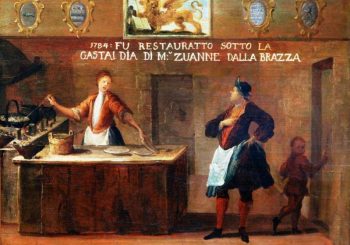
The image above represents the Insegna dell’Arte dei Fritolèri, oil on wooden panel, 1784. Among the signs of the Venetian guilds, there is also the sign of the guild of the fritolèri, nowadays held at the Correr Museum. The Government of the Serenissima had imposed a curious rule on the fritolèri: they could turn freely around the city to sell their sweets but without offering them out loud!

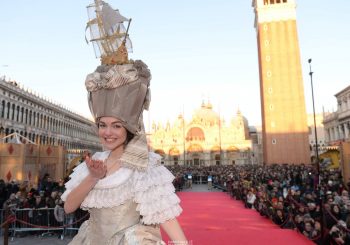
THE FLIGHT OF THE ANGEL – St. MARK’S SQUARE 24th FEBRUARY 2019 12.00 a.m.

The “Flight of the Angel” is a traditional event that goes back to the Serenissima period where an unknown guest of Venice, flying along a rope from San Marco bell tower to the middle of the square, will offer an homage to the Doge, and will be greeted by the crowded parterre of the period costumes parades of the Historical Re-enactments.
As a conclusion, the embrace of the Angel and the Doge will smooth the atmosphere of a square galvanized by scenographical effects always appreciated by the Italian and international networks. The girl winner of the 2018 edition of the “Festa delle Marie” (Marie contest), Erika Chia, will be the Angel of the new Carnival 2019. This year the “Flight of the Angel” will be predated by the”Flight of the Fighter Angel“, namely Micol Rossi, 2018 Maria of Gazzettino newspaper readers, as a testimony of her brave path. Costume made by Atelier Pietro Longhi.
The “Doge” Parade is organized by C.E.R.S. – Consortium of European Re-enactment Societies, with the participation of Ass. Amici del Carnevale di Venezia, Ass. Internazionale per il Carnevale di Venezia and Ass. Dame e Cavalieri.

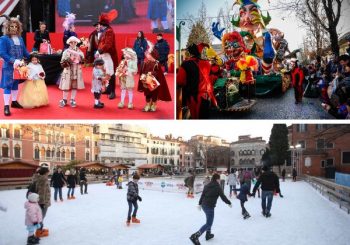
CARNIVAL WITH KIDS

Celebrate Carnival in Venice by introducing kids to a fabulous experience. Venice, during winter, has a special charm and Carnival with its street fun and games, costume parades and colourful folklore would be such a good experience for them.

Theatre shows, music, workshops and much more in program for children and families for Carnival 2017 in Venice and in the mainland from February 16th to March 5th.

Here is a selection of events for children:

Carnival features a series of masquerade balls, parades (on both land and water), puppet shows, musical performances, and the Best Mask Contest – Kid’s Edition on March 4th 2019, Kids’ Carnival in Zelarino on March 5th 2019 and Carnival in Murano on February 24th and in Burano from February 28th to March 5th 2019