THE “SENSA” FEAST – MAY 13th 2018

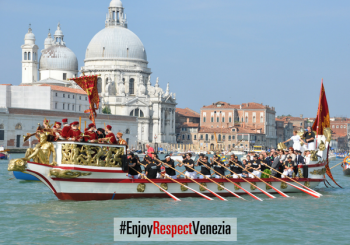
The roots of the Sensa Feast-day, on the occasion of Ascension Day (in Venetian dialect Sensa) lie in the history of Venice and more specifically in two episodes: the conquest of Dalmatia by the Venetians and when Doge Ziani acted as mediator between Pope Alexander III and Emperor Frederick Barbarossa (Peace of Venice, 1177).

The Marriage of the sea ceremony took place on the occasion of this feast.  The Doge of the Serenissima used this rite to demonstrate the Republic’s dominion in the Adratic. The doge and his entourage embarked on the Bucintoro. On reaching the mouth of San Nicolò port, the Doge threw a gold ring into the sea.

The symbolism of the mystic marriage to the sea is still evident and is certainly still valid today. The Mayor of Venice, civic dignitaries and religious and military representatives leave Saint Mark’s Square and sail to the Port of S. Nicolò where the ritual ring throwing takes place.

From “DeTourism”

“SQUERI” IN VENICE

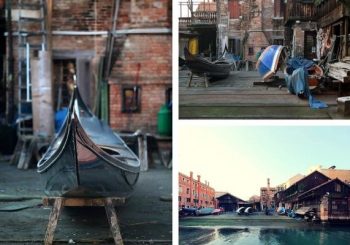
In Venice you can still find the squeri, small boatyards where expert craftsmen build and repair wooden boats. The squeri are just as ancient as Venice itself, everything is still the way it used to be. Just  a few steps away from the usual tourist routes, you can meet the last master boatbuilders  – you can count them on one hand –  that pass on the art of building gondolas and all other typical lagoon boats the sandoli, sanpierote, caorline, topi, cofani.
Traditional squeri are usually built on a courtyard that slopes down towards the water to launch or tow boats, whereas manufacturing is carried out inside a teza, a wooden warehouse built on brick pillars, which can sometimes have another storey where the squerariol (the boatbuilder) lives.

Here are four squeri to visit:

Squero San Trovaso at Dorsoduro 1097 Along the Rio San Trovaso, from before the seventeenth century. The building that houses it is reminiscent of an alpine cabin: both the carpenters and the construction timber came from Cadore; the inclination of the square in front and the roof covering it were useful in case of rain, as well as a deposit for work tools.

Squero Domenico Tramontin & Sons at Dorsoduro 1542 whose boatyard in the Ognissanti area is worth a visit – they have been building gondolas since 1884. Among the many curiosities on display is the collection of blades, tools, oarlocks and other objects which once belonged to famous owners, including the house of Savoy. 

Squero Crea Giudecca 212, owned by Gianfranco Vianello (aka Crea), a champion rower; his is the only squero which supplies gondolas complete with all the accessories including oarlocks and oars.

The last one is the squero of Costantini-Dei Rossi in Giudecca, 866 / A, who, although young, is a faithful follower of the traditional methods and the only one, apart from Crea, producing other types of vessels as well as gondolas.

From “DeTourism”

SLOWFOOD CE – EUROPEAN PROJECT – MAY 4th 2018

CULTURE – HERITAGE – IDENTITY – FOOD

The City of Venice organized a training day at our Vivaldi Room on May 4th, 2018 aimed at stakeholders of the European Slowfood-EC project for a participated mapping of the Venetian gastronomic heritage.

For further information:

slowfoodce@comune.venezia.it


DIAGNOSTICS AND TREATMENT OF MENINGIOMS: STATE OF THE ART 3rd and 4th MAY 2018

The important conference organized by CO.GEST M. & C. Srl, Verona on the diagnosis and treatment of meningiomas took place in the Aula Magna.

Scientific Board:  Dr M. Naddeo, Dr. A. Pasqualin, Dr G. Pinna, Dr M. Skrap e Dr L. Volpin

For infomation: cogest@cogest.info oppure tel. 0039 045 597940

WALKING IN SEARCH OF THE WELLS IN VENICE

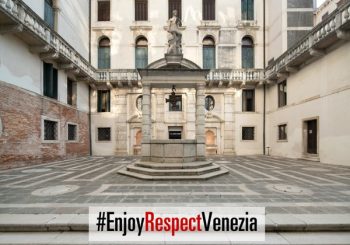
Beyond the most popular itineraries, Piazza San Marco, the Bridge of Sighs and the Rialto Bridge, there are whole areas of Venice to be explored to fully understand the authentic soul of this millenary city. Why don’t you look for the itinerary suggested by the Sustainable Tourism Service of the City of Venice to the participants of the 40th Su and Zo per i ponti (Up and down the bridges)? Discover the wells of Venice: walking around Venice, in fact, you can often come across the wellheads, authentic works of art scattered in every corner of the city.
The unmistakable appearance of “campi”, courtyards, cloisters and gardens of Venice would not be such as we know it without the wells, today no longer in use but for centuries an essential element of Venetian daily life, at least until the construction of the first aqueduct, at the end of the nineteenth century . The wells, thanks to an ingenious system for the collection and filtering of rainwater, assured to a city built on the brackish water of the lagoon, the supply of fresh water: “Venice is on water and has no water”, so in fact wrote Marin Sanudo, Venetian historian and chronicler, around the early 1500s. The Venetian well is an underground cistern for the collection, purification and conservation of rainwater, and the wellhead is the visible part of the real well. You can see different wells, some of which are very old, a in the Archaeological Museum and the Natural History Museum of Venice.

FROM “DeTourism”