The Centuries-Old History of Venice’s Greek community

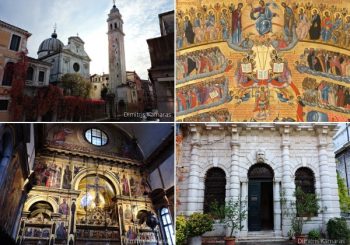
A Greek community has long existed in Venice, but after the fall of Constantinople, in 1453, the Greeks grew considerably and by the end of the XV century they were about four thousand, and constituted the most important foreign component in the Serenissima. With the permission of the Venetian authorities, the Greeks gathered in a secular brotherhood: it was the 28th November 1498 when the Consiglio dei Dieci authorized them to establish the Confraternity of the Greek Orthodox or Scuola Greca, whose purpose consisted in charity and mutual assistance. This year the confraternity celebrates 521 years from its foundation.

Between 1539 and 1573 the Scuola Greca built the splendid Church of Saint George (San Giorgio dei Greci), the oldest and most important church of the Orthodox Diaspora. The church now hosts the Greek Orthodox Archdiocese of Italy and Malta. Gradually a whole Greek neighborhood took shape around the Church, within the Castello district. From the Riva degli Schiavoni, the Church of San Giorgio dei Greci can be easily recognized for its leaning bell tower. As in other Eastern Christian churches of Byzantine tradition, the interior space is divided by the iconostasis, a solid screen of stone, wood, or metal, separating the sanctuary from the nave. That of the Church of San Giorgio dei Greci, in marble, is covered with icons of the post-Byzantine Cretan painter Michael Damaskinos. The most important work in the Cathedral is the inspiring icon of Christ Pantokrator (brought to Venice from Constantinople just before the Turkish conquest), considered one of the most beautiful Byzantine works ever, according to the French writer André Malraux.

In 1949, the immense patrimony of the Scuola Greca was entirely donated to the Greek State, founding the Hellenic Institute of Byzantine and Post-Byzantine Studies in Venice, the only Greek centre abroad dedicated to research and studies. It is located in the monumental complex of the Campo dei Greci, and has a rich library, with about two thousand ancient volumes printed by the Greek publishers in Venice from the 16th to the 18th century, a precious archive and a museum of Byzantine and post-Byzantine icons. Housed on the first floor of the Scoletta of San Nicolò dei Greci, erected by Baldassarre Longhena in 1678, this museum – unique in Europe – contains one of the most important collections of Byzantine and post-Byzantine icons, 80 works of art, ranging from the 14th to the 18th century.
CARPACCIO AND THE DALMATIAN SCHOOL

In Venice there were many scuole, confraternities, or lay brotherhoods, founded as devotional institutions, that were set up with the purpose of providing mutual assistance. The scuole also depended on the state, which exercised a protective and supervisory role. Each scuola had its own meeting house where the members gathered: these buildings still today preserve an extraordinary historical and artistic heritage.

By the sixteenth century, there were over two hundred scuole in Venice, among which there were six Scuole grandi, devotional scuole with their specific religious connotations. Today there are four Scuole grandi still active in Venice: Carmini, San Giovanni Evangelista, San Rocco, San Teodoro.

There were also other types of scuola in Venice, the Scuole minori, such as the scuole of the arts and crafts, which protected the interests of different categories of workers and regulated their activity. All the trades were represented: the “Botteri“, those who made barrels; “Curameri“, those who worked leather; “Forneri“, who made bread; “Frutaroli“; “Pistori” and many others.

Then, there were the national Scuole which grouped the members of each foreign community in the town. For example, the Scuole of the Milanese, Lucchesi, Albanians, Germans, Florentines. Also the synagogues in the Jewish Ghetto were called Scuole, because of their role both social and religious.

The Scuola Dalmata di San Giorgio e Trifone, also known as San Giorgio degli Schiavoni, is one of these national scuole, founded with the intention of bringing together residents in Venice from the Dalmatia region (now part of Croatia). The Scuola Dalmata was recognized in 1451 – following the conquest of Dalmatia by the Venetians – as a confraternity of sailors, soldiers and emigrants belonging to the Dalmatian community in Venice. Schiavoni is the term with which the inhabitants of the Dalmatian islands were called at the time.

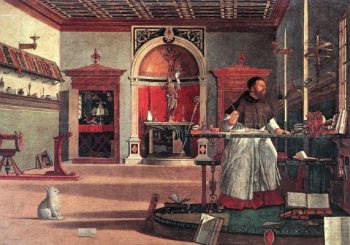
The ground floor of the Scuola Dalmata houses one of the most extraordinary painting cycles of the early Venetian Renaissance, executed by Vittore Carpaccio in the early sixteenth century. This cycle of paintings narrates the stories of the confraternity’s patron saints George,Tryphon and Jerome. The masterpiece in the series is certainly the Vision of St Augustine. The Saint is caught in the instant in which the voice of St Jerome distracts his attention from a letter he was writing to him, to advise him of his imminent death and ascent to heaven.

The building of the Scuola Dalmata was renovated in 1551, when the façade was covered with white Istrian stone and the bas-relief with Saint George was made for the portal. Just above the high altar is a precious relic of Saint George. The Scuola Dalmata was one of the rarest religious institutions which managed to keep its artistic heritage intact and in the same premises, notwithstanding the decree of Napoleonic suppressions.

SNAIL STAIR DEL BOVOLO

The so-called Snail Staircase must rank as one of the best hidden sights to track down in Venice, lost in a maze of narrow streets not far from the Rialto bridge. In a hidden courtyard, a stone’s throw from Campo Manin, in the San Marco district, the Contarini del Bovolo staircase emerges in all its extraordinary beauty. This is the most imposing spiral staircase in Venice, 28 meters high, from whose belvedere you can admire the domes of the Basilica di San Marco and of the Basilica della Salute, and a breathtaking view of the roofs and bell towers of the entire city.

This architectural jewel is part of the Palazzo Contarini del Bovolo, a late-Gothic palace built between the 14th and 15th centuries as the residence of the Contarini family. At the end of the 15th century the Contarinis decided to embellish their palazzo with an external spiral staircase, a project by a local architect, Giovanni Candi. The Snail Staircase acquired so much popularity that eventually the word “bovolo” – which means “snail” in Venetian – became part of the last name of the family, which in the end would be known as Contarini dal Bovolo (the Contarinis of the Snail). In the courtyard, there is a small garden with arks and wells from the church of San Paternian (demolished in the nineteenth century when the campo where it stood was transformed and named after the patriot Daniele Manin), including a beautiful Venetian-Byzantine well from the 11th century.

The loggia on the second floor of the Scala del Bovolo leads to the Sala del Tintoretto, a prestigious room in Palazzo Contarini where you can admire the collection of Venetian art from the 16th to the 18th century belonging to the IRE public institution, current owner of the building and administrator of all the shelter institutions spread throughout the city.

From “DeTourism”

VENETIA TRIOMPHANTE – ARTISTIC AND HISTORICAL ITINERARIES OCT.-NOV. 2019

EBT ENTE BILATERALE TERRITORIALE UNITARIO SETTORE TURISMO DELLA PROVINCIA DI VENEZIA, organized in our Sala Canova a course of art and history about Venice.

For information, please contact:
EBT ENTE BILATERALE TURISMO PROVINCIA DI VENEZIA
Mrs. Chiara Pesce
Tel. 0039 041 5093133

NEXT – DIABETES 2 – SALA GOLDONI 11th and 12th OCTOBER 2019

Cardiovascular diseases are the leading cause of death for patients with diabetes: among these patients, in fact, the main cardiovascular risk factors are more frequent and result in more serious consequences than the general population.

In the treatment of type 2 diabetes, optimal management of glycemic values ​​is the first level of therapy and represents the foundation of the profession of diabetologist. However, nowadays it appears more and more evident and important for the doctor to evaluate the high impact that cardiovascular diseases have on diabetes and on the management of this disease and consequently, consider this fundamental aspect in choosing the best drug therapy for the diabetic patient.

The new therapeutic options for type 2 diabetes are presented to the diabetologist as innovative solutions able to offer beyond the glycemic control, a proven protection from cardiovascular risk.

Recent studies have evaluated and demonstrated the effects of long-term treatment of some of these drugs on cardiovascular morbidity and mortality.

The most recent Italian guidelines (Italian standards for the treatment of diabetes mellitus 2018) have accepted the new scientific evidence and proposed a new algorithm for the treatment of type 2 diabetes that includes the most important classes of innovative drugs with particular attention to those with proven effectiveness in terms of cardiovascular protection.

A training course was held in our Goldoni Room on 11 and 12 October, which will allow participants to deepen the link between type 2 diabetes and cardiovascular risk, implementing knowledge of the new classes of drugs and their use in patient care diabetic.

The initiative is an interactive training project, of national importance, whose goal is to give the diabetologist the new evidence on type 2 diabetes and cardiovascular protection, with particular regard to the class of SGLT2 inhibitors.

For more information, contact:

ABOUT EVENTS SRL

Tel. 0039 02 89634651

www.aboutevents.eu