CHIMNEYS IN VENICE

“The magnificent, trumpetlike chimneys resembling medieval turrets in the backdrop of every Madonna and Crucifixion idle and gradually crumble away from the local skyline” (Iosif Brodskij, Watermark)
Strolling around Venice with your nose in the air, you will see a large number of chimneys of different shapes. They’re part of Venice’s fascinating minor architectural heritage, they are structural elements, with a precise functionality, important part of its landscape.
Venice counts about 7,000 chimneys, evidence of the gradual historic-architectural stratification of the city.
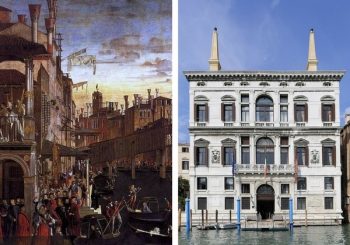
You will see dozens of different shapes: bell-shaped,on the roof of Palazzo Dario; double or triple fork shape, in Fondamenta della Misericordia.  You can recognize a truncated cone shape chimney from the Bridge of Pugni in San Barnaba; a cylindrical or  cubic shield, covered by Istria stone, in campo Sant’Agostino; a truncated pyramid shape from  Ponte Pasqualigo in campo Santa Maria Formosa;  a dado shape on the San Stae canal; a cusp-shaped in marble, like that of Zecca, in Piazza San Marco, by Jacopo Sansovino; a bell tower shape in campo San Fantin; the obelisk-shaped ones on the roof of Papadopoli Palace.
In the paintings of great painters like Carpaccio, Bellini, Canaletto we find the Renaissance Venice in these unique artifacts, an outstanding example of Venetian art of chimney construction.

From “DeTourism”
PROMISING PRACTICES – 9th -11th October 2017

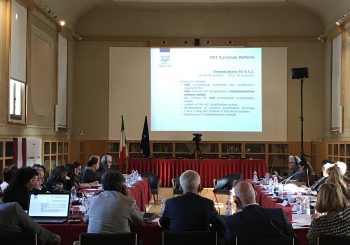
Under the patronage of the Ministry of Education, University and Research was held in our Center from 9 to 11 October u.s. an international conference under the “Promising Practices” project aimed at drawing up the guidelines that will be submitted to the European Parliament to ensure that the diplomas of the professional institutes of each country are recognized in all European Community countries.

In the presence of the representatives of France, Germany, Greece, Latvia, Slovakia, Portugal (absent at the last moment Spain for internal political problems), Dr. Gianni Maddalon, Head of the Department for Educational Education and Training System, General for School Orders and Evaluation of the National Education System has opened the conference “MAKING VOCATIONAL EDUCATION AND TRAINIG (VET) – A FIRST CHOICE – Second Meeting for a European Peer Learning – Platform on Vocational Education and Training” this city, as an Italian venue for the meeting, Venice being the artifacts city of excellence, that is, crafted by art by skilled craftsmen’s knowledge, and therefore the most suitable place could be found except for Artigianelli, which many boys have formed and started thanks to the professional schools of the Opera Don Orione and that today, in another form, he also works in support of culture.

The event ended with great satisfaction.


AUTUMN IN VENICE

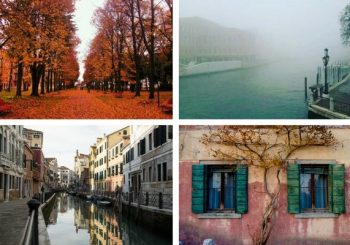
Autumn can be a wonderful time to visit Venice: the crowds of the summer have gone and Venice shows its more authentic version, the Venetians’ everyday city, still plenty of things to see and do.
In October, the first Sunday celebrates Festa del Mosto – the must from the harvesting of wine grapes – in Sant’Erasmo. Visitors can join the locals to taste the island’s best produce and specialities.
6-8 October is Garden festival a special occasion for walking in colourful fall red-gold-orange gardens, often closed to the public.
Thousands of running entusiasts will run the Venicemarathon on 22nd October starting from Stra along the Riviera del Brenta, finish line at Riva Sette Martiri in Venice.
Do not miss the Biennale Arte (until November 26), the new exbitions and the theatrical season (Check our Calendar of events).
On 21st November the Feast of Madonna della Salute is celebrated, with a temporary bridge over the Grand Canal to the Salute Church and special masses.
It is a very Venetian feast. Even today, thousands of people make the pilgrimage to pay homage to the Virgin and to light a candle asking her to keep them in good health. The procession of believers passes stalls selling sweets, coloured balloons and toys. Special foods are prepared just for this day.

From “DeTourism”


CATHOLIC ACADEMY OF BAVARIA – 26th-30th September 2017

The Catholic Academy of Bavaria celebrates this year’s 60th anniversary of foundation. At the center of his daily work, at his congress venue in Munich, there is an offer of information and training on various subjects: humanistic, theological, artistic and scientific. On the occasion of the Biennale Arte di Venezia, the Academy organized, for the fifth time at our Center, the Art Week from 26 to 30 September 2017 with a hundred participants. The first evening was held at our Magna Aula. Here Dr. Florian Schuller, after the greeting of the rite, introduced the arch. Don Gianmatteo Caputo, who is responsible for the Patriarchal Curia of Venice and the dioceses of Triveneto for cultural and ecclesiastical heritage, illustrating the relationship between church and art, in particular has laid out the logic of positioning works of art and their interaction with the environment within churches as places of worship. The intervention was particularly appreciated by the participants. In the following days, the visits of the pavilions of the Biennale to the Gardens and the Arsenal and the side exhibitions taking place in the palaces and churches of Venice were organized; two national pavilions (Antigua-Barbuda and San Marino) are housed in our Center. Three leading experts and artisans, Prof. Thomas Raff, Dr. Wilhelm Christoph Warning and Dr. Walter Zahner, as well as artist Christoph Brech, accompanied the guests.

Further information: Dr. Astrid SCHILLING and Dr. Michael ZACHMEIER

www.kath-akademie-bayern.de


GANDALF PROJECT – 23rd e 24th September 2017

Gandalf Project was founded from the encounter between the world of engineering and finance. “AI” (Artificial Intelligence) is a branch of engineering that deals with computer techniques to replicate some of the processes characteristic of biological organisms, able to solve complex problems such as trading decisions.

In particular, in the eighties, with the advent of early computers, some large financial institutions fueled research in the field of genetic algorithms and neural networks. It passed by the validation of discretionary systems, optimization of automated systems, through the characterization of models of risk management.

Further information: Ing. Giovanni Trombetta

trombetta.giovanni@gmail.com  Mobile +39 3349491210