VENICE – NATURALISTIC ITINERARIES

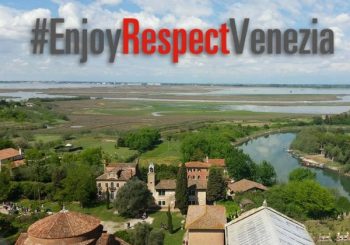
Venice, for many visitors, is often only a must-see destination, they’re acquainted with  movies, books, songs or major events such as  the Biennale, museums, Carnival or the palaces on the Grand Canal, but beyond and all around Venice stand the Venitian lagoon. Download the map of the Lagoon

Let’s live Venice slowly, beyond the clichés, get lost to find out the real Venice, discovering the lesser-known islands of the lagoon, walking, biking or by boat.
Old farmers’ and fishermen’s villages are waiting for you to take part in the traditional festivals,  to get a taste of local life and exchange tales with locals. Take  a chance to observe the flora and fauna of these fragile wetlands, follow the naturalistic itineraries and experience the traditional fishing or learn about the lagoon flora and fauna.
If you’re interested in visiting the oasis, dunes and the pine forest of San Nicolò and the wetlands of Santa Maria del Mare, nothing better than the cycling path along the coast of Lido and Pellestrina. Take the vaporetto ACTV

Remember that bicycles are forbidden (even when only lead by hand) in Venice city centre

From “DeTourism”
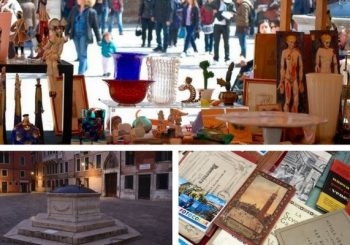
 

FLEA MARKETS IN VENICE SEPTEMBER 2017

12 good rules for the responsible visitor make up a sort of handbook with advice and recommendations to become travellers that are more aware and respectful towards Venice’s landscape, environment, artistic beauties and identity.

1. Discover the hidden treasures of Venice in the least visited places to appreciate Venice’s exceptional beauty.

Campo San Maurizio is one of the most beautiful squares in Venice: in the Saint Mark’s district, it houses several interesting palaces from an architectural and historical point of view. On the west side, the Palazzo Bellavite,  frescoed by Paolo Veronese, was home to the poet Giorgio Baffo and Alessandro Manzoni who lived there from 1803 to 1804, while the church of Saint Maurizio, of very ancient building construction, was in the 18th century the atelier of the sculptor Antonio Canova.

The Flea and Vintage Market in Campo San Maurizio, in the weekend from September 22 to September 24, is the appointment not to to be missed in Venice, with over fifty dealers exhibiting on typical wooden benches under wide tents, unchanged since the 1970s, the setting up of the market.
Ancient and rare books, paintings, fans, lamps and mirrors, passé memorabilia and prints, vintage dresses and Burano old laces are on display for the enthusiasts and collectors of antiques and collectibles.


From “DeTourism”


The European Heritage Days 23-24 September 2017

The European Heritage Days are back and in the last weekend of September (23-24) in Venice the doors of the most interesting monuments, buildings, premises and areas are open to the public. You can choose among  walks and guided tours in premises usually not open to the public, and historical nature walks in the islands.

For The European Day of Languages, September 26th, high school students of Veneto will present multimedia products focusing on the promotion of linguistic diversity at Santa Marta Theatre.
September 27 is World Tourism Day. This year’s theme, International Year of Sustainable Tourism for Development, is “Sustainable tourism: a tool for development”.
The City of Venice launched for the International Year of Sustainable Tourism for Development, the awareness campaign #EnjoyRespectVenezia designed to direct visitors towards the adoption of responsible and respectful behaviour towards the environment, landscape, artistic beauties and identity of Venice and its inhabitants. The objective is to raise awareness of tourist impact, with the belief that responsible travelling can contribute to sustainable development.

On September 29th, for VENETONIGHT – the European Researchers’ Night, media events, performances, experiments, conferences, exhibitions, children’s activities,  guided tours will take place in the cities of Venice, Padua and Verona.
From “DeTourism”


HISTORICAL REGATTA SEPTEMBER 3rd 2017

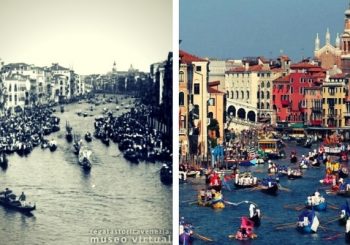
The Venetian-style rowing continues to live in the rowing season but its peak is the famous Historical Regatta. On the first Sunday of September, the spectacular race takes place in the Grand Canal. The event opens with the historical procession of splendid festive boats with hundreds of figures re-evoking the triumphal welcome accorded by the Serenissima to the Queen of Cyprus, Caterina Cornaro, who, in 1489, had “donated” her kingdom to Venice. This year the dragon boats, in Venice for their championships, participate in the parade of boats in the Grand Canal
Then the races start, preceded by the regatta of children on two-oared mascarete, followed by the race for the Very Young on twin-oared pupparini, then by male crews on 6-oared caorline. Then it’s up to the International Universities Boat Challenge on eight-oared galleons by the crew of Ca’ Foscari and Iuav Universities, the University of Padua, the University of Vienna, and the University of Warwick. Then women’s race on two-oared mascarete, and the high spot of the event sees the famous rowing champions compete on gondolini.

#EnjoyRespectVenezia

FROM “DeTourism”


EAT AND DRINK IN VENICE

Traveling is a way of living,  a way of knowing the culture, traditions and social rules of a place. So why do not start discovering Venetian culinary tradition?
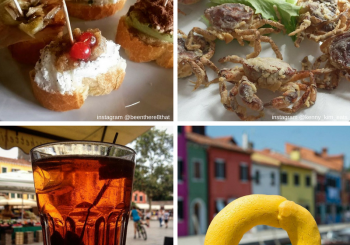
Venice is a seaside city and our traditional dishes contain seafood. However there are also recipes with vegetables coming from the islands, e.g. artichokes from the island of Sant’Erasmo, pumpkin, asparagus, radicchio, beans and peas.  “Cicheti”

(Venetian tapas), wine and bacaro tour (the inns tour) area typical Venetian.
To keep clients sober, Venetian vendors that were ahead of their time, invented a type of street food. So, according to seasons and availability, the following cichèti appeared on the stalls: “folpeti” (boiled octopus), “castraure” (early season, violet-coloured baby artichokes from the island of Sant’Erasmo), croutons with “bacalà mantecato” (creamy salted codfish), “sarde in saor” (tasty fried sardines) – an emblem of Venetian fusion cooking, fried vegetables, cured meats, various cheeses, all the parts of quinto quarto (i.e. offal) from the “rumegal” (little pieces of beef rumen), “spienza” (calf spleen), “trippa rissa” (herb-flavoured boiled tripe) “nerveti” (nerves served with raw onion).

When visiting Venice, a  UNESCO World Heritage site, adopt responsible and respectful behaviour towards the environment, landscape, artistic beauties and identity of Venice and its inhabitants.  #EnjoyRespectVenezia

FROM “DeTourism”